
Tiger out of the shadows
Watching tigers in India
A few years ago I travelled to India to see tigers. I visited the three main national parks of Kanha, Bandhavgarh and Ranthambhore, where tigers can still be seen and tiger populations are reported to be steady. During my stay I enjoyed 24 sightings of 16 different tigers over a three week period.
Seeing a tiger for the very first time was certainly a moment to remember. You watch tigers on television documentaries, but nothing prepares you for actually seeing the 3 metre length of the tiger glide effortlessly by you. It made quite an impression, as did the deep gorges that its claws had left in a tree used as a scratching post over 3 metres up from the ground.

Seeing a tiger felt surreal. But that may have had more to do with the fact that I was perched on the back of an elephant at the time and the mahout – the man in charge of the elephant – kept asking for a cash advance to see the tiger for a little bit longer, which did turn the experience into a bit of a circus.
It was certainly a far cry from my usual peaceful wildlife sightings on the Yorkshire Wolds. But it was India after all – where anything can happen. Poverty is everywhere in India and I found the sheer rawness of it a real shock, to say the least. On top of that the effects of the poverty on the landscape were dramatic. In some places oddly shaped dead tree stumps are all that are left to remind you of the forests that once prospered. These have gone to provide firewood to a desperate population.
The national parks meanwhile are lushly forested and flow with clean water. To travel between the two was a bizarre experience. It was if you had been transported magically from one country to another in the short distance it took to cross the boundary between outside and inside a park.
Ranthambhore National Park
Nowhere was this distinction more apparent than between the dust ball shanty town of the village of Sawai Madhopur and the adjacent Ranthambhore National Park. Locals will proudly tell you its ‘Where Bill Clinton came’, not that this in itself appears to have done any good. Ranthambhore National Park in Rajasthan is a jewel of a national park, with vast lakes, dramatically ruined temples and palaces, densely forested areas and deep gorges.

Its original purpose was as hunting grounds for the Hindu Raj. It was here I had one of the most spectacular wildlife-watching moments of my life. My wife and I had hired a driver to guide us through the park and after bumping along the dusty roads for days in sweltering 45 degree heat, we had had no sightings of tigers. We paused under a tree in the shade to escape the oppressive temperatures and think up a new plan for our tiger hunt.
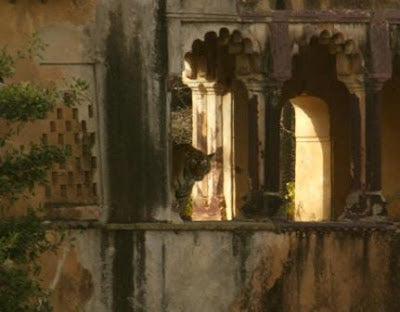
The scenery was breathtaking. Below us was a lake covered in water lilies and beyond it a distant temple slowly being enveloped by the surrounding forest. As gazed at the temple I spotted a tiger looking out of one of the arches. I grabbed my binoculars to confirm the sighting. ‘Tiger, tiger, tiger’ the driver shouted, leaping around the jeep excitedly in a most peculiar fashion so that it was hard to actually watch what was going on. This tigress was a long way off and protected from the noise, fortunately, by the vast stretch of water between us.

She purveyed the scene nonchalantly. Some distance away, a group of samba deer munched waist deep in the lake on tender water lily stems. As the deer moved unwittingly towards the tiger, a flash of mischief flickered across this predator’s eyes, and I knew: she was going to have a go at hunting. Moments later, she swirled around in excitement, and then reappeared in the archway. With that she leapt down from the temple and started charging through the water towards the samba.
Tiger hunt
The samba scattered, calling out alarms as they galloped, but both deer and the tiger were encumbered by the deep water. It was as if it was all happening in slow motion.

The tiger singled out an individual and steered it towards a rocky causeway which separated the lake in half. She pursued the samba with great gusto for 100 metres or so. But then, just when she was a whisker away from an easy meal, she missed her footing and stumbled. She had let her prey get away, and was clearly disgruntled, flicking her tail angrily at her clumsiness and glancing back to see where she had gone wrong.
Our guide had continued to jump up and down and shout ‘tiger, tiger, tiger’ throughout the sighting which had made getting these shots even more challenging. The strength and power of that tiger was breathtaking to watch.