Raising young can be hard work for any parent, but among the animal parents I most admire are those that won't be deterred from the job at hand - like the female wren I watched who worked tirelessly to feed her chicks despite the efforts of her mate to distract her.
Discovering a wren nest
I spotted the wren whilst on the Scottish coast at Burnmouth. I was there to watch gannets and puffins, but this wren's dedication to her brood absorbed me and I watched her for a week. I discovered the nest after hearing the young chicks whilst walking towards the beach. As I peered into the brambles a wren popped out and flew off.
She had built her nest in a tuft of grass overhanging a rock, just five feet from the road. I stayed for a while and before long the wren was back bearing food for her tiny chicks. After finding the nest, I spent any spare time I had that week watching the comings and goings. It was fascinating to watch the mini dramas of family life unfold before me.
Spotting the chicks
The wrens became so accustomed to me that I could sit on the bank just over a metre away while the female fed her chicks. This is quite unusual behaviour for a wren; normally I have to use a hide. A few days later the chicks had grown already and their beaks were just showing out of the entrance hole of the nest. Soon the chicks would be popping their heads out of the hole and I wanted to be there to see it happen. Wren feeding its chick, photographed by Robert E Fuller
An insect diet
From my close position I could see what the wren was bringing in. Hoverflies, caterpillars, damselflies, crane flies, aphids and even small beetles were all on the menu. Sometimes she would forage quite close to me disappearing beneath some undergrowth or grasses. The way she scurried about reminded me more of a mouse’s behaviour than that of a bird. I noticed that it was the female who attended to the hunting and feeding duties. I didn’t see the male feed the chicks once. He spent most of his time showing off, by singing and flashing his wings at her.
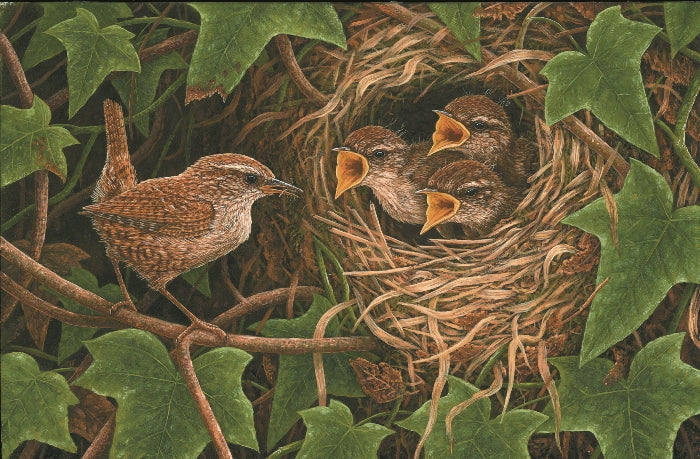
He seemed to be trying to tempt her into a nest that he had built further up the bank. A pair of wrens can have two or three broods a year. But she wasn’t in the least bit interested and disappeared beneath the undergrowth calling out in annoyance each time he approached with further amorous advances. Wren and Chicks, painted by Robert E Fuller
Inspiration for a new painting
By the end of the week I was delighted to see the chicks popping their heads out of the nest hole as the female approached. This was the moment I had been waiting for all week and just what I needed to produce a painting. I laid down on the bank and the female soon arrived on the scene.
Four chicks saw her approach and popped their heads out of the entrance hole of the nest begging for food. I got a great photograph of these tiny little chicks with their gaping mouths. There were more chicks in there but the entrance to the nest was too small for them all to fit through - the others would have to try their luck next time.
Catching a moth
On another occasion, the female disappeared under a tuft of grass and flushed out an orange under wing moth and then pursued it across the road. She caught it then pecked furiously at it, banging it onto the tarmac. It was quite a tussle but she managed to disable it by taking off one wing before deftly removing the other. She bashed it a few more times for good measure before taking it to the nest and stuffing it down one of the chick’s throats. I was quite surprised that this little chick was able to swallow such large prey. It certainly got a good meal.
I was so entranced by what I was watching some six and a half hours passed before I realised that the day was drawing to a close.
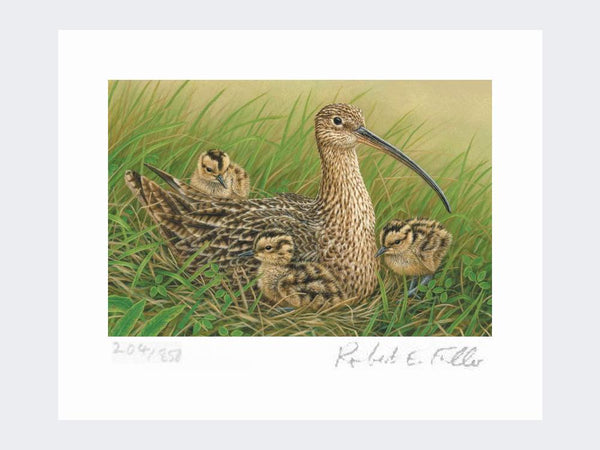
: invalid url input --> "Curlew and Chicks")