
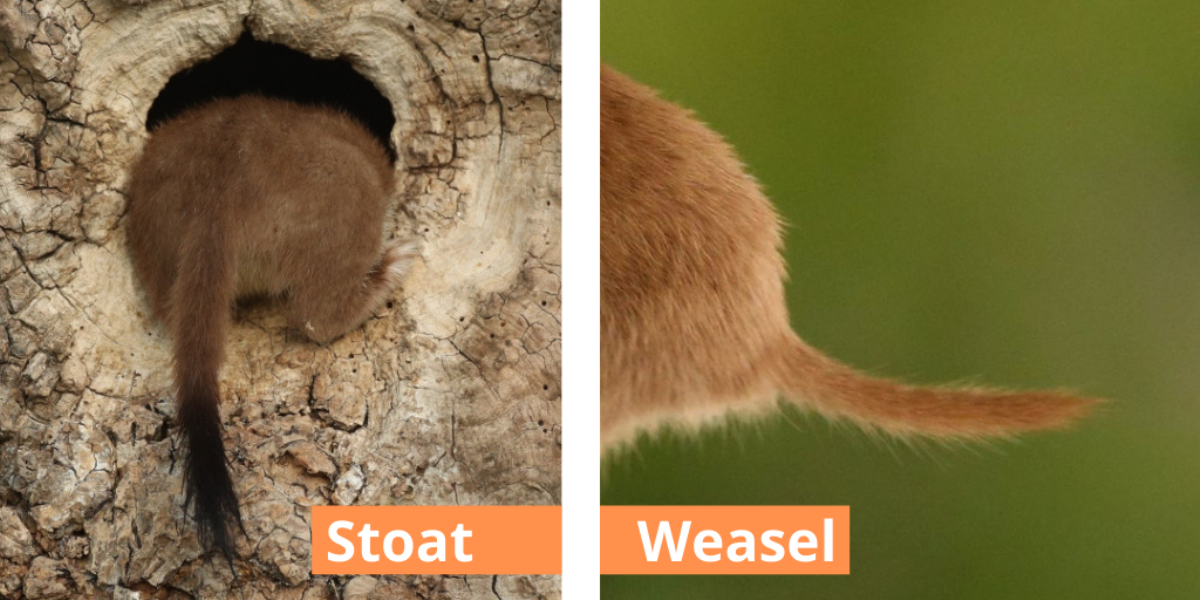


There is a saying that ‘a weasel is weasel-ey recognised and a stoat is stoat-ally different’, but it only serves to confirm how difficult it is to tell the two species apart.
These little brown mustelids are both fast and ferocious, with sinuous bodies and short legs. But there are a few key indicators to look for if you see a tiny, slim brown mammal slip through the undergrowth at speed.
Black tip to the tail: The most important of these is that stoat’s tails have a bristly black tip whereas the weasel’s tail is much shorter and light brown all the way to its tip.

Look at the line where belly meets back: On a stoat there is a clean, straight line where the cream fur of her belly meets the brown fur of her back. On a weasel, it is very jagged. If you get close enough to these animals in the wild to see this line, it is a good way of telling weasels and stoats apart.
Size matters: Stoats are always bigger than weasels. In simple terms, think of a weasel as a long sausage, whereas a stoat is more like a cucumber. There is quite a difference between the males and females of each species. A female weasel is truly tiny weighing just 65g whilst a male stoat is just over five and a half times heavier at 360g.
White in winter: Stoats are the only one of the two that has the ability to turn white in winter. Although not all stoats turn white, it’s down to genetics – so just because it is winter don’t dismiss a brown-furred stoat as a weasel, use the guidelines above.
In Latin: The Latin name for the weasel family is Mustela. In the UK the sub-species, 'mustela nivalis, is known as weasel. In the US, the same animal is called a least weasel. Meanwhile the Latin name for the animal known in the UK as a stoat and in the US as a short-tailed weasel, is 'mustela erminea', a reference to the fact that a stoat is able to turn white, or ermine, in winter.

Read more:
Stoats & Weasels - Much maligned in History
Mustelids and Me: The wonderful world of Weasels and Stoats as featured in BBC Countryfile Magazine June 2018
Watch my weasel and stoat videos on Youtube




: invalid url input --> "Curlew and Chicks")





1 comment
Dieser Artikel ist offenbar maschinell übersetzt und das leider sehr schlecht. Im Deutschen sind Hermelin und (Großes Wiesel) nämlich dasselbe. Unterschieden werden Großes und Kleines Wiesel (Mauswiesel).