
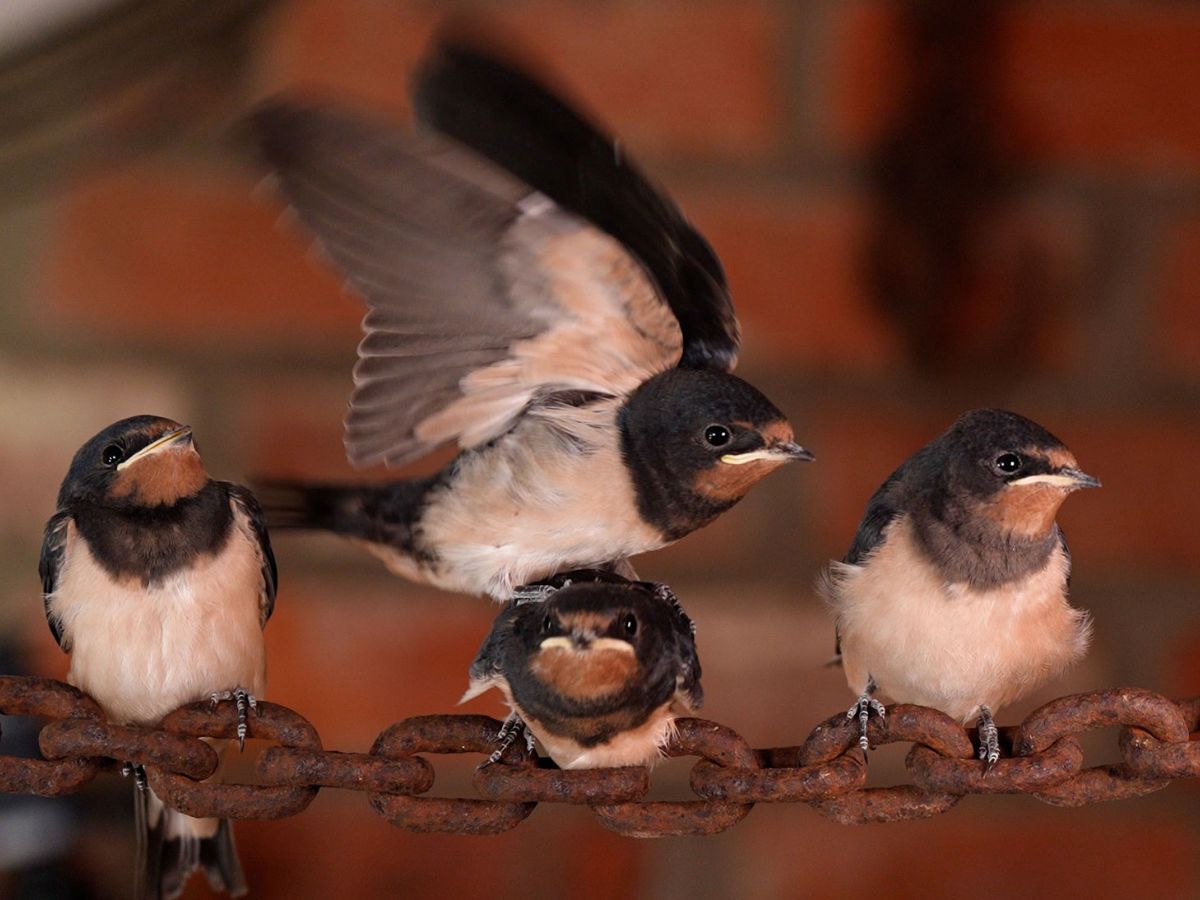
All summer, I was treated to the chatter of swallows. First they nested in my back porch, then they practised their first flights around the back garden, perching on the washing line and sleeping, all in a line on a chain slung across the porch.

Preparing for swallows
Now they've gone. Taken off on their 6,000-mile flight back to their winter grounds in Africa. I miss them. More so than most years, since, although swallows nest in my porch every year, this is the first time I’ve really studied them. From the moment I heard the first swallow sing out in mid-April, I’ve followed their every move – filming them from inside a small loft space above the porch and even hiding a remote camera above their nest.
Known as barn swallows across their worldwide range, these sleek, darkly iridescent birds migrate from the southern to the northern hemisphere each year, normally landing in Yorkshire in spring. I began preparing for their arrival in March, even building them a nest to give them a head start. With luck, they might even squeeze in two broods over the summer. I chose to build it inside an old storm lantern which swallows have nested in before and was the backdrop for the painting below.
Read the story of this painting was inspired by swallows nesting in a storm lantern

Using wet mud, dead grasses, and a splash of PVA glue to bind it all together, I set about making the replica nest. I needed both hands and all my fingers and thumbs to mould it all into a cup shape - to think swallows build these using just a beak. Once it was ready, I hung the lamp up in the porch and turned my attention to my prepare for filming. First, I hung up an old, rusted chain for the pair to perch on as they flew to and from the nest – again this would be a good backdrop to my artwork.
Next, I drilled a hole into the wall of the porch from the loft space above. My plan was to feed a probe lens through this so that I could climb into the loft and film into the heart of the nest. I then added shelving brackets to hold my cameras and built a second hide on the other side of the porch where I could sit and watch the action.
Arrival announced with song
All these preparations took several days, and I was only just in time when I heard the male singing. A loud, chattering sound ending in a distinctive trill, this song is sung exclusively by males to proclaim their territory. I was so relieved when, the very next day, the female flitted silently in to join. They had both made it safely back. At first glance male and female swallows look very similar, but males have much longer tail streamers and are more iridescent in colour.
I was delighted when both birds instantly perched on my chain and within days set about lining my nest with dead grasses and feathers. Mostly they chose wood pigeon feathers, but I noticed the downy feathers from young tawny owls go in too. The swallows would arrange these so carefully, each feather elegantly echoing the curve of the nest. As they worked, the male often sang out. I kept the back door open so that the house rang out with the cheerful sound - who needs music or TV when you can enjoy this pure sound from nature.
Six, freckled eggs
At last, the female, after fussing over a few final arrangements, began to sit inside the nest. And then, on May 7th, she laid her first egg. It was tiny. Just 20mm long, and a beautiful off-white colour offset with small dark chocolate-coloured freckles. She laid a new egg each day until there were six.

Interestingly, during the first two nights she roosted on the rim of the nest, whilst the male perched on lantern top above her. But after the third egg, the female moved to sit on the clutch overnight. After she had laid the sixth and final egg she incubated the eggs full time. It was fascinating to record the process. Sometimes my observations contradicted what I’d read about swallow behaviour.
For example, I an article online claimed male swallows took turns at incubating the eggs. But my remote cameras had this nest under 24-hour surveillance, and this male didn’t incubated them once. He would sit on the rim of the nest and guard the eggs, but never on them.
Chicks hatch
On the 14th day of incubation, I noticed half an eggshell on the floor of the porch, right underneath the chain. I quickly ran into the office where a monitor displayed the action from a remote camera. On the screen, I could just glimpse the top of a chick’s head over the rim of the nest. As I watched, the male arrived with beak-full of small insects – a sure sign that a chick had hatched.
I grabbed my cameras and climbed up into the loft. Carefully, I pushed my probe lens through the hole I’d drilled back in March. Inside I could see not one, but three chicks. And then, ensconced in my loft, I filmed the fourth chick breaking its way out of the shell. It emerged blind and naked, save for a few wispy strands of fluff above its eyes and on its back that made it look like an aged punk rocker. It wasn’t long before the male arrived with its first meal. He was very attentive, bringing in beaks-full of tiny flies and insects all day long. Each time he arrived in the porch, he would call out and then pause, perched on the chain, until the female left the nest to make space for him to feed the chicks.
She would only leave once she heard his call, as if waiting for reassurance that it was him and not an interloper. It was fascinating to see how the pair divided up their duties The male was clearly in charge of food whilst the female brooded. Occasionally she would also bring back a small insect or two, but these were measly offerings compared to the male’s abundant deliveries. He would spend longer feeding the chicks too, offering new helpings to each chick in turn.

I sat in the loft for the rest of the day waiting for the last two eggs to hatch but after 12 long hours cramped in the loft alongside our suitcases in the sweltering summer heat, I decided to call it a day. The next morning, I was back in the loft in time to film the last two chicks hatch. There was a comical moment as the fifth chick emerged. One half of the eggshell was stuck to the top of its head; the other half balanced on the head of a sibling. As both chicks wriggled, the shells wobbled above them like ill-fitting helmets.

The male look confused when he arrived with dinner but then promptly picked off the closest shell-hat and flew away with it. The other chick, the one that had just hatched, managed to shake off its eggshell helmet, but when the female arrived, she also took it away. Birds do this to keep the nest space clean and deter predators. This pair also ate the faecal sack, waiting for the chicks to poop after each meal to snap it up.
First meals
The male was bringing food in every few minutes now. As he landed on the rim of the nest, he would call out loudly and the chicks would open their beaks wide in response. Generally, he fed two or three chicks on each visit. He was so fast it was hard to identify exactly which species, but occasionally I spotted flies and even aphids going in.
 Swallows catch flying insects and store them in a pouch in their throat, cramming the hoard firmly into the space so that by the time they are regurgitated to feed to the chicks they resemble insect pellets.
Once the chicks were around five days old, the female began spending more time off the nest, leaving the chicks for several minutes at a time to help the male hunt for food. It was fascinating to see how, as the chicks developed, the adults adjusted their behaviour accordingly. I too changed my behaviour. When the chicks were new, I whispered to my family, asking them to creep in and out of the house as quietly as possible. But now we were going in and out as normal.
Growing fast
By day six, the chicks’ eyes began to open. They had grown so much the female no longer brooded them, even at night. Instead, she would sit on the rim of the nest to watch over them and then, as soon as dawn broke, head out with the male to catch insects.
Once they were around a week old, the chicks’ heads became visible over the rim of the nest. They could now see the adults’ approach and would open their beaks in unison the moment one swooped into the porch. As each beak stretched wide, their bright orange gapes now showing, the calls would intensify: ‘Feed me, feed me.’

By this stage the adults were only feeding one chick on each visit. The male would fly in and out in a split second, barely landing on the nest as he dropped a few insects into one of the gaping mouths. In contrast, the female landed with just a few insects, fed these to a chick and then rummaged around the nest searching for any dropped insects - which she then fed to the remaining chicks. I suspect she was also searching for unwanted parasites since I once saw her eat what looked like lice. She would jettison anything she didn’t like the look of, including misplaced pigeon feathers.

Feathers grow & chicks learn to stand
Soon the chicks shed their fluffy down and grey pin sheaths grew in their place - the black adult feathers just showing at the tips. Each day the difference was remarkable. From day 10 to day 14, they went from downy chicks into glossy swallows. They learned to stand up, flap their wings and preen and even how to turn around and poop over the rim of the nest!

One of the most fascinating things was watching them track flies - their heads would all move in unison and if a fly came too close one beak would inevitably snap out. As the days passed the swallows chicks began to look, well, more like swallows.
First flights
Then, on the 17th day after hatching, I they began to take turns to stand on the rim of the nest and flap their wings, leaning backwards and swaying dangerously over the edge. Information I had gleaned online claimed swallows fledge at 20 to 22 days from hatching, but the first two from this clutch fledged on day 18, catching me unawares.
I went out on the porch to see the new fledglings perched on the chain. There was quite a commotion as they called back to the chicks in the nest and these chicks called back. Meantime the adults’ noisy calls added to the general sense of chaos. I crept slowly up into my hide to film the remaining chicks take their first flights. This was possibly the most magical part of the project.

Their flights were short, their range limited to within the porch, but by the next day they had made it to the washing line outside the porch and back. Later, once they were ready to venture further, an adult would fly alongside as they practised, calling encouragingly. That first night the fledglings lined up to roost on the chain in the porch, side by side, heads tucked under wings.

New life on the wing
The adults stayed close during these early days – often calling out sharp warnings if a sparrowhawk or a kestrel flew too close – and the family spent a lot of time on the washing line and the roof around the porch: the chicks mainly gathered up in a line waiting for their parents to deliver food.


Meals were now delivered entirely on the wing, the adults hovering over the clutch stuffing food directly into the line of gaping mouths. At first, I wasn’t sure how they managed to apportion it evenly, but after a while I noticed there was a pattern to each deliver. I got so good at predicting which end of the line was due a feed I could train my camera on the next gape to be filled.
The chicks were cheeky. I often saw them shuffle along the chain pecking and pushing at one another with the same sense of mischief they’d shown when they were all in the nest together. 
Sometimes, they perched along the guttering close to the porch, and I’d see one drop down into the gutter and run along behind the others pulling at their tail feathers. When an adult swooped all six chicks would instantly revert to their ‘hungry chick’ act, calling out for food.

During the first few days they were exclusively fed by the adults. But they grew increasingly interested in passing flies and by the sixth day I watched a flying chick swerve its course, open its beak and actually catch a fly.
A new brood
Shortly after this there came a big change in the lives of these young swallows. The adults began building a new nest. It was being constructed out of fresh cow pats, probably because it hadn’t rained in weeks and there was no mud available. I filled a small plastic tray with water and took it out to the field, burying it in the ground next to the cow pat and mixing soil in to create a muddy pool.
I popped back home for breakfast and by the time I was back out the swallows had found my mud patch and were flying back and forth from the porch with this new supply of nesting material. I took a chair out to the field to film them gather the mud and before long the juvenile chicks also turned up to see what was going on.
They perched in a row along a barbed wire fence next to me, opening their beaks to beg for food each time an adult passed. But the adults, intent on their new task, ignored them. At first the chicks were curious. They flew down to the mud patch, their wings quivering as they called for food. When their parents continued to ignore them, the chicks pecked at the mud, as if wondering if this was a new food source. I watched them spit it out in surprise. Now dividing my time between the porch and the field, I watched the nest slowly take shape.

 The swallows mixed mud with grass, then dibbled the putty into place with their beaks, adding a new layer as soon as the first dried enough to be tacky. Just as all this was going on, our mains water pipe sprung a leak and the workmen told me they’d have to dig up the porch steps to lay a new pipe. I was tempted to delay the work until after the second brood had fledged, but for my gallery to remain open we needed running water.
In the end I needn’t have worried because the swallows barely hesitated and within a week their nest was the size of a half a cereal bowl. The day the workmen finished we got our first egg. Interestingly that evening I heard the male swallow call out. The noise sounded like an alarm call and I rushed out expecting to see a predator. All I could see were the four juveniles roosting on the chain.

The next day the female laid another egg and again at dusk I heard the same sound. Then I then realised what was happening - the male was trying to chase the first brood of chicks away. Just two weeks after fledging, these youngsters were now on their own. So much so that even after the second brood fledged, the parent birds would chase away any lonely first brooders who tried to return to the porch to roost.
When the swallows then gathered along the power lines ready for the long journey back to Africa, it was clear how important this independence is for their survival. I wish them all a safe flight. It’s been an incredible process watching them grow up and I can’t wait to see them back again next year.
In the meantime, enjoy these paintings inspired by barn swallows I have watched here.
 Swallow fledglings, limited edition art print
 Swallows 'Time for Tea' limited edition art print
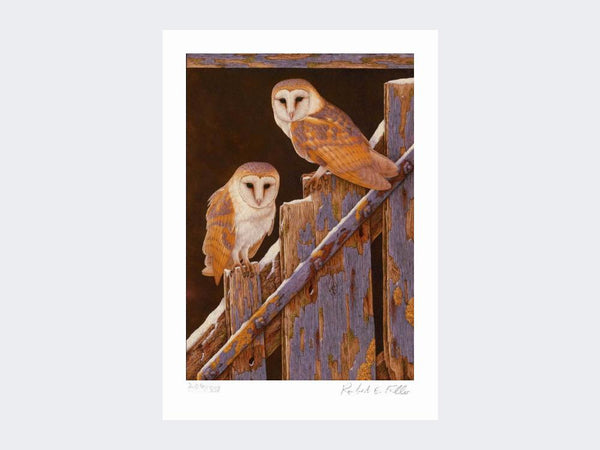
: invalid url input --> "Barn Owls in Window")




1 comment
Robert your narrative along with the pics painted a picture in my mind that allowed me to experience a feeling of being right there witnessing their development as you filmed it. Lovely time out of our chaotic world for me and I’m sure others. Thankyou.