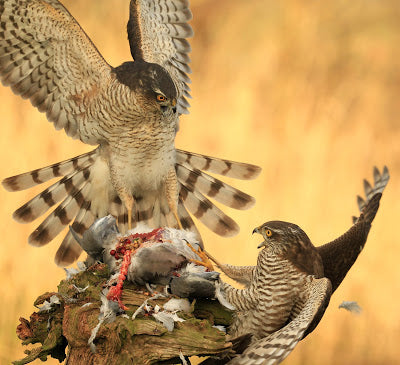
This week I won 'highly commended' in the 2015 British Wildlife Photography Awards for this photograph of two sparring sparrowhawks.

I traveled down to London to collect my award on Wednesday - and took the opportunity to photograph deer in Bushy Park at the same time - perhaps the subject of another blog! The picture, which won highly commended in the animal behaviour category, is now on display alongside the other winning photographs at London's Mall Galleries. It will go on to be published in a book showcasing all of this year's winners. I am pleased at the way I caught the two birds in the frame; their talons locked in deadly combat, their wings outstretched in hostility.

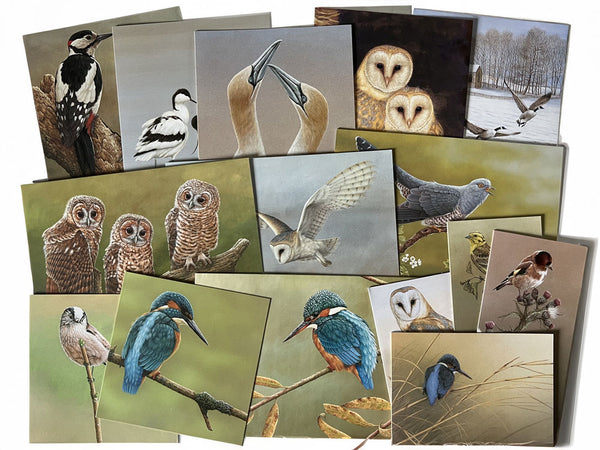
But in fact this photograph was taken as background research for the painting below.
 Sparrowhawk, painted by Robert E Fuller
Readers of this blog will remember I spent six months persuading a female sparrowhawk to feed regularly in the garden so that I could photograph it up close. I wanted a model I could rely on to get the kind of photographs I needed for the details in my painting so I had to get it feeding from the same spot every day - where I could be there ready to photograph it.

This was a particular challenge as sparrowhawks only hunt live prey. But they don’t always finish their meal in one go and will often leave a kill half eaten to come back to. With this in mind, I decided to take a carcass from a sparrowhawk kill and slowly move it a few metres away each day until it was in a convenient place for me to photograph. But first I needed to work out how I could exchange a sparrowhawk kill with offerings of my own - so that if I did I could get a sparrowhawk to return to the same spot again and again. I decided to try out my plan on the female sparrowhawk that visits my garden. If I was successful it would mean I could photograph her everyday – and at the same time keep her away from the song birds on my bird table!

I noticed that she would often perch on top of the swing seat in the garden, so I began by leaving a partially-eaten pigeon there. This didn't interest her at first, but then the wind picked up and moved the wings of the pigeon - she spotted it and went on to feed! It took a long time to gradually persuade her that there would be food every day - and then move the spot to where I could watch, but eventually I had her. Then one day a new and more aggressive young female sparrowhawk moved in. I was first aware of her presence when I heard the garden birds chattering urgently in alarm.
My sparrowhawk stopped eating and turned to face the direction of the noise. Suddenly she fanned her tail and lowered her head in a defensive posture.

With astonishing speed a second hawk came into the frame. The original hawk flapped her wings up in the air and fanned its tail even wider, to make herself look as large and threatening as possible.
But the second hawk was not going to be put off. She made a grab for the pigeon, tugging on its wing. It then lunged at the other hawk, pushing it off the kill.

It was an explosive moment. My camera can take up to ten frames a second and captured some astonishing images that were too quick for the human eye.