Enjoy a trip to Robert's gallery in Thixendale | What's on - Visiting info - Opening times - Directions

Help me name Luna and Shadow's owlets 🦉

Gannets of Bempton inspire new paintings

Gannets of Bempton inspire new paintings

Gannets of Bempton inspire new paintings

Robert E Fuller

Gannets are inspirational

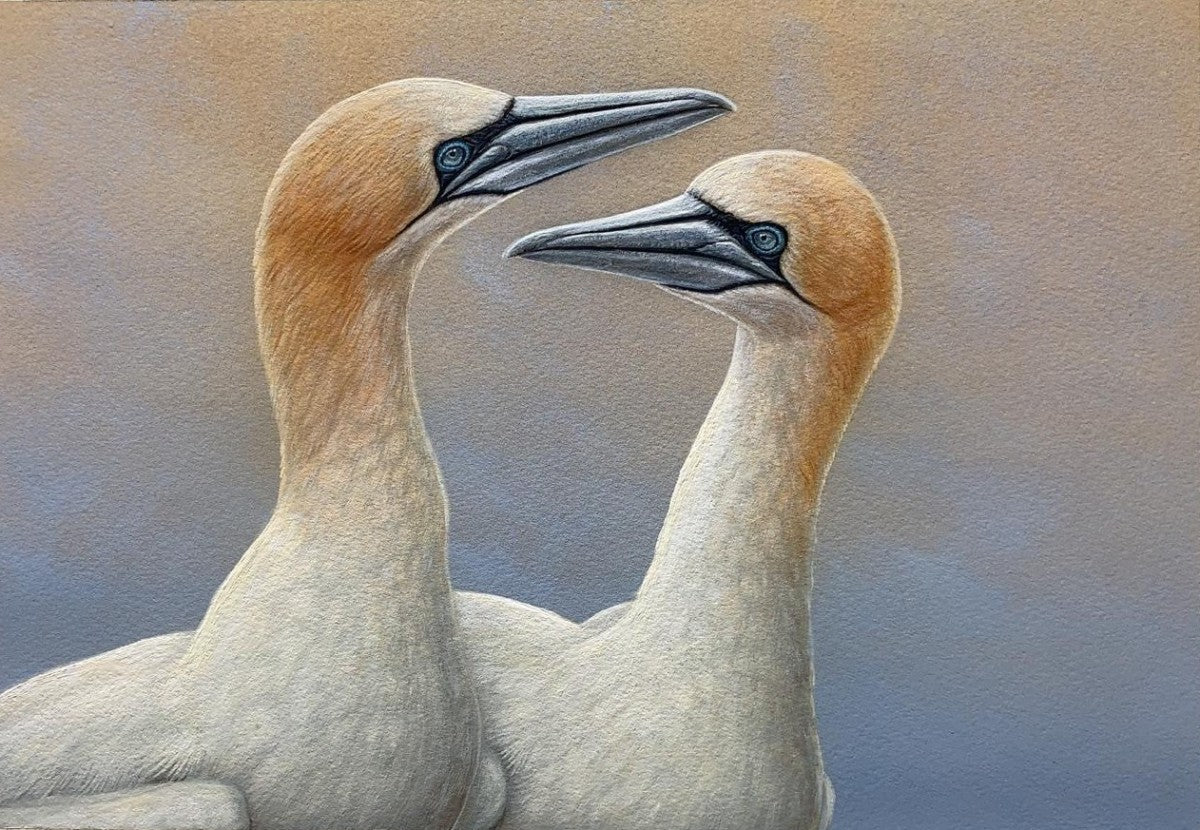
Gannets have always fascinated me, mostly because they make such excellent subjects to paint. They are large birds with pure white feathers that finish in sleep black wing-tips. Their heads are a yellow colour that fades gradually into the neck and they have bright blue beaks and eyes. As an artist, I’ve always appreciated their graphic faces, which look like they have been drawn on with a fine black pencil line.

gannets painted on east coast of yorkshire


When to see gannets in Yorkshire

Gannets are out at sea for most of the year, but from March onwards, pairs start to arrive back to their birthplace to begin an elaborate courtship with partners to whom they remain faithful for life.

Gannet courtship behaviour

This ritual begins with a bow. The pair will lower their heads to each other and then raise their beaks skywards, their bodies forming a perfect point, before they settle down to preen each other tenderly.


Gannets dive at alarming speeds

The UK's largest seabird, this bird is built for life at sea. It has an impressive 6ft wingspan and an aerodynamic shape which looks striking against a blue sky. Gannets reach speeds of up to 60mph as they dive down from heights of up to 30m, their wings held out like daggers as they drop.


Gannet bubble wrap

Fascinatingly, they can do this without coming to any harm due to special air sacs in their face and chest which cushion the impact as they plunge into the water, much like bubble wrap would protect the impact of a fall. They also have binocular vision, which helps them to judge distances accurately as they continue to pursue fish underwater.

gannet rspb bempton


Inspired by gannets in Yorkshire

Gannets nest in fantastic numbers at a colony at RSPB Bempton, here on the East Yorkshire coast. The recent population boom here was a tremendous success story. It began with just a handful of pairs back in the 1980s and has grown to the astonishing 11,000 pairs that now cling along the cliff edges. The best place to see one is a rocky arch called Staple Newk. The colony at Bempton Cliffs, an RSPB-owned reserve, is actually now the biggest mainland colony in the British Isles. I'm so lucky to have it right on my doorstep. 

When I visited Bempton recently, the noise coming from the colony was deafening. Gannets swirled around the colony overhead, to-ing and fro-ing from hunting missions at sea. The birds were packed so tightly together on their rocky home that it was a wonder they could squeeze their large, cumbersome frames on to the small ledges where they nest. Each nest was just pecking distance apart from its neighbour. But the proximity of these nests provides security to the whole colony, protecting the chicks from marauding gulls which fly overhead looking for an easy meal.

Inspired by gannets in Scotland

For me, the only disadvantage to this incredible sight is the vantage point. Although it is possible to get some eye-level flying shots of gannets, at Bempton you look down from the cliff top on to the colony quite some distance further below. So recently I traveled up to the Bass Rock in the Scottish borders, home to a staggering 60,000 gannets, to see if I could get any better shots. The Bass Rock is about 1.5 miles offshore from North Berwick and has a distinctive in shape. From a distance, it looks like a large snow-covered boulder but the white sheen is actually gannets, and guano.


On a clear day you can spot tiny specks of white around its edges. These are the gannets circling the rock. It is difficult to secure a landing on this uninhabited volcanic rock island, and bad weather during my visit meant that it was impossible to land. I made do with a boat trip that simply sailed around the rock, which although wasn’t the real deal, gave me a taste of what the island had to offer.

As I got closer, there were so many gannets swirling overhead that the sky was completely filled with them criss-crossing the sky, and every spare inch of rock was taken with nesting birds. Occasionally, a gannet would stand up and reveal a big blue egg, or another time a white, downy chick. The noise of the colony hit you, as did the overpowering smell that 60,000 fish-eating gannets could produce. I was pleased to cruise around the Bass Rock, but was disappointed not be able to land. I’ll just have to keep my fingers crossed for next time. Until then I’ll be back at Bempton for another look. 

Summer is the best time to watch gannets

March is the time to watch gannets. Visit the RSPB Bempton Cliff website for more information and a map. It is also possible to take a seabird cruise to Bempton Cliffs, where you get to see gannets swoop, swirl, and dive for food around the boat.  Call 01262 422212 for more information or to book. For more information on the Bass Rock and to book a boat trip, visit the Scottish Sea Bird Centre.


After watching gannets, visit my gallery

The Robert Fuller Gallery, Fotherdale Farm, Thixendale Y017 9LS


If you are going to watch puffins at Bempton Cliffs, my gallery is just a half-hour drive away along the A166 towards York and makes a lovely addition to your day out. You can see my paintings of puffins alongside photographs, limited edition prints and more paintings of wildlife from around the world.


Paintings inspired by gannets


painting of pair of gannets beaks pointing up

Gannets Sky Pointing | Original Acrylic Painting | Shop here


gannets painted on east coast of yorkshire

gannet painting by Robert E Fuller


Related Posts

All About Puffins & How They Inspire My Art
Puffins are everybody's favourite seabird and it's not hard to see why....
Paintings & films inspired by bird nests
Bird nests come in all shapes and sizes. From woven...
7 Red Squirrel Paintings That Really Show Their Personality
With their tufted ears, russet coats and quick, lively movements,...
Wildlife art inspired by mothers in nature
Art for mothers day This Mother's Day I've been focusing...
Planting a wildflower meadow for wildlife art
Planting a wildflower meadow Instead of a lawn, I planted...
Quest to find a heronry ends in city park
Portrait of a heron A grey heron is a beautiful...
The art of building beautiful bird boxes
A rare, living elm tree On the wooded slope of...
4 Things I Learned About Hawfinches During a UK Hawfinch Invasion
Hawfinches are a rare sight here in the UK. So...
10 wildlife paintings inspired by spring
Welcome to this collection of paintings inspired by wildlife in...
Unique Christmas Gifts for Nature Lovers
Christmas gifting has never been easier with this collection of...
5 Mothers day gifts for mums who love nature
5 Mother's day gifts for mums who love nature Whether...
Stoats & weasels in art | A collection inspired by intensive field studies
This collection of 16 paintings of stoats and weasels follows...
Travel | Adventures in Antarctica Inspire Colourful Art Collection
My collection of penguin paintings are the result of an...

Leave a comment

Please note: comments must be approved before they are published.

Gannets are inspirational

Gannets have always fascinated me, mostly because they make such excellent subjects to paint. They are large birds with pure white feathers that finish in sleep black wing-tips. Their heads are a yellow colour that fades gradually into the neck and they have bright blue beaks and eyes. As an artist, I’ve always appreciated their graphic faces, which look like they have been drawn on with a fine black pencil line.

gannets painted on east coast of yorkshire


When to see gannets in Yorkshire

Gannets are out at sea for most of the year, but from March onwards, pairs start to arrive back to their birthplace to begin an elaborate courtship with partners to whom they remain faithful for life.

Gannet courtship behaviour

This ritual begins with a bow. The pair will lower their heads to each other and then raise their beaks skywards, their bodies forming a perfect point, before they settle down to preen each other tenderly.


Gannets dive at alarming speeds

The UK's largest seabird, this bird is built for life at sea. It has an impressive 6ft wingspan and an aerodynamic shape which looks striking against a blue sky. Gannets reach speeds of up to 60mph as they dive down from heights of up to 30m, their wings held out like daggers as they drop.


Gannet bubble wrap

Fascinatingly, they can do this without coming to any harm due to special air sacs in their face and chest which cushion the impact as they plunge into the water, much like bubble wrap would protect the impact of a fall. They also have binocular vision, which helps them to judge distances accurately as they continue to pursue fish underwater.

gannet rspb bempton


Inspired by gannets in Yorkshire

Gannets nest in fantastic numbers at a colony at RSPB Bempton, here on the East Yorkshire coast. The recent population boom here was a tremendous success story. It began with just a handful of pairs back in the 1980s and has grown to the astonishing 11,000 pairs that now cling along the cliff edges. The best place to see one is a rocky arch called Staple Newk. The colony at Bempton Cliffs, an RSPB-owned reserve, is actually now the biggest mainland colony in the British Isles. I'm so lucky to have it right on my doorstep. 

When I visited Bempton recently, the noise coming from the colony was deafening. Gannets swirled around the colony overhead, to-ing and fro-ing from hunting missions at sea. The birds were packed so tightly together on their rocky home that it was a wonder they could squeeze their large, cumbersome frames on to the small ledges where they nest. Each nest was just pecking distance apart from its neighbour. But the proximity of these nests provides security to the whole colony, protecting the chicks from marauding gulls which fly overhead looking for an easy meal.

Inspired by gannets in Scotland

For me, the only disadvantage to this incredible sight is the vantage point. Although it is possible to get some eye-level flying shots of gannets, at Bempton you look down from the cliff top on to the colony quite some distance further below. So recently I traveled up to the Bass Rock in the Scottish borders, home to a staggering 60,000 gannets, to see if I could get any better shots. The Bass Rock is about 1.5 miles offshore from North Berwick and has a distinctive in shape. From a distance, it looks like a large snow-covered boulder but the white sheen is actually gannets, and guano.


On a clear day you can spot tiny specks of white around its edges. These are the gannets circling the rock. It is difficult to secure a landing on this uninhabited volcanic rock island, and bad weather during my visit meant that it was impossible to land. I made do with a boat trip that simply sailed around the rock, which although wasn’t the real deal, gave me a taste of what the island had to offer.

As I got closer, there were so many gannets swirling overhead that the sky was completely filled with them criss-crossing the sky, and every spare inch of rock was taken with nesting birds. Occasionally, a gannet would stand up and reveal a big blue egg, or another time a white, downy chick. The noise of the colony hit you, as did the overpowering smell that 60,000 fish-eating gannets could produce. I was pleased to cruise around the Bass Rock, but was disappointed not be able to land. I’ll just have to keep my fingers crossed for next time. Until then I’ll be back at Bempton for another look. 

Summer is the best time to watch gannets

March is the time to watch gannets. Visit the RSPB Bempton Cliff website for more information and a map. It is also possible to take a seabird cruise to Bempton Cliffs, where you get to see gannets swoop, swirl, and dive for food around the boat.  Call 01262 422212 for more information or to book. For more information on the Bass Rock and to book a boat trip, visit the Scottish Sea Bird Centre.


After watching gannets, visit my gallery

The Robert Fuller Gallery, Fotherdale Farm, Thixendale Y017 9LS


If you are going to watch puffins at Bempton Cliffs, my gallery is just a half-hour drive away along the A166 towards York and makes a lovely addition to your day out. You can see my paintings of puffins alongside photographs, limited edition prints and more paintings of wildlife from around the world.


Paintings inspired by gannets


painting of pair of gannets beaks pointing up

Gannets Sky Pointing | Original Acrylic Painting | Shop here


gannets painted on east coast of yorkshire

gannet painting by Robert E Fuller