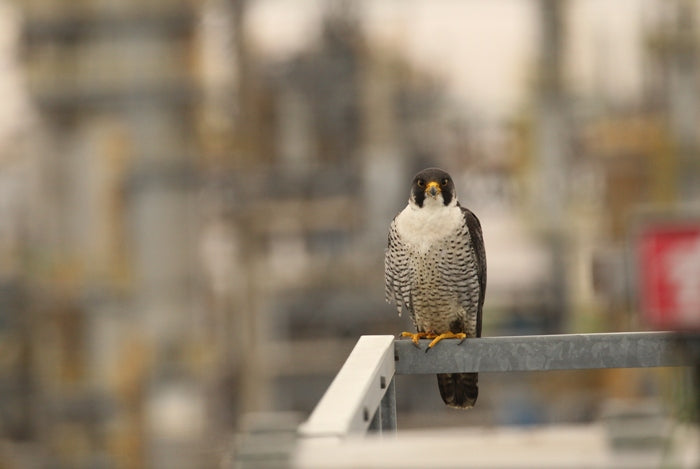
This is the story of a pair of peregrines that lived high on a cooling tower at Salt End, a vast industrial chemical park on the banks of the Humber Estuary.
Far above one of Europe's busiest ports in an industrial landscape of belching chimneys and vast cooling towers, the world’s fastest bird had made this harsh and unforgiving environment its home. The air there was heavy with the smell of industry and there was barely a blade of grass in sight - the last place you would imagine life thriving. But this peregrine and its mate were quite at home, even though as they swooped amid the steel and concrete the roar of industry beneath was deafening.
Defying all odds, I watched this pair bring up five generations of chicks here.
Peregrine origins
The adult female wore a black ring on her leg tracing her origins to a nest on Chichester Cathedral. This meant after hatching she had left the elaborate turrets of her medieval home and flown some 200 miles to settle on a chemical plant in Hull. Meanwhile the male peregrine had the remains of jesses on its legs and so was possibly once a captive bird.
The clue was in the food
A study of the feathers and bones in the peregrine nest revealed that their decision to settle at Salt End was in fact quite astute. The industrial park was situated on the banks of the Humber Estuary, a major route for migrating birds and this pair feasted on a varied diet that included little grebes, pigeons and even quail.
Permission to film
Only a handful of people in the UK are licensed to film peregrines on their nest, but I was even luckier as I was the only one allowed to film the nest at Salt End, from a hide on a 100ft high scaffold tower overlooking the nest. The scaffold was constructed especially for me by staff concerned at how to protect these birds at this 500 acre power plant.

From this unique vantage point, I has followed the intimate story of this peregrine pair for two years.
Filming the nest
The project was the result of a huge team effort involving staff working across a number of different companies based at Salt End Chemical Park and represented an admirable example of industry embracing conservation. Among those involved were Mike Sibley, of BP, Paul Rees, of Vivergo Fuels, Paul and Vince Chambers, who built the peregrine pair a deluxe nesting box.

The inspiration for new paintings
The intensive peregrine study went on to inspire a new collection of paintings.