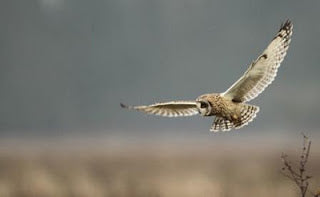
After hearing of an influx of short eared owls close to the Humber estuary, I set off to find them. It wasn't long before I spotted eight, hunting together above the shores of the Humber and was rewarded by some fascinating behaviour. I watched spellbound as these winter migrants co-ordinated their attacks to see off a buzzard and even a marsh harrier, before one of them was chased off by a kestrel - a much smaller but clearly more tenacious bird.
Short eared owls
This owl species is truly nomadic in the sense that they will migrate over 1,000 miles in search of good hunting grounds or to escape bad weather. Living near the east coast of England, I am perfectly placed to see the first arrivals from further north. These owls favour large areas of rough grass, estuaries and marshes where they are more likely to find voles, their preferred prey.
Daytime hunters
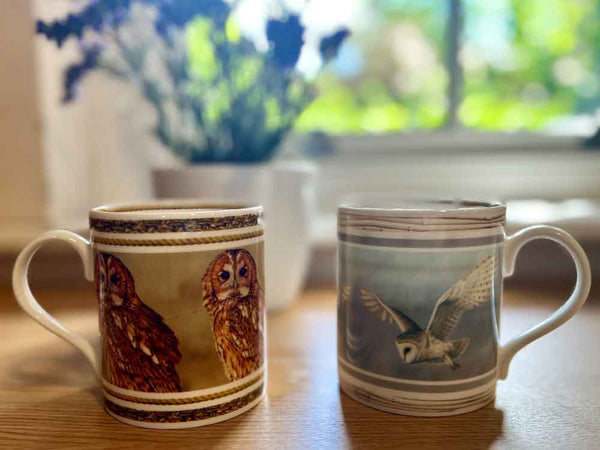
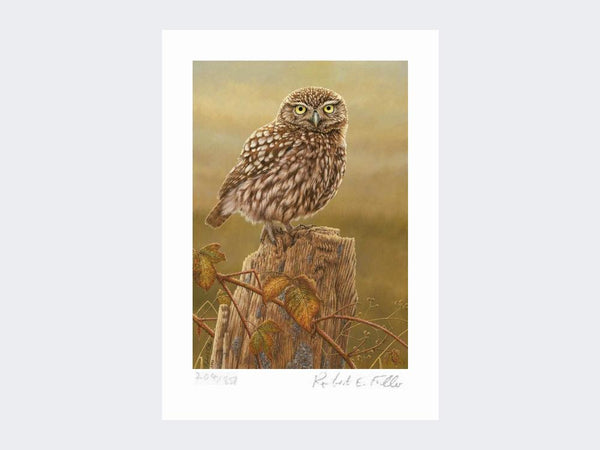
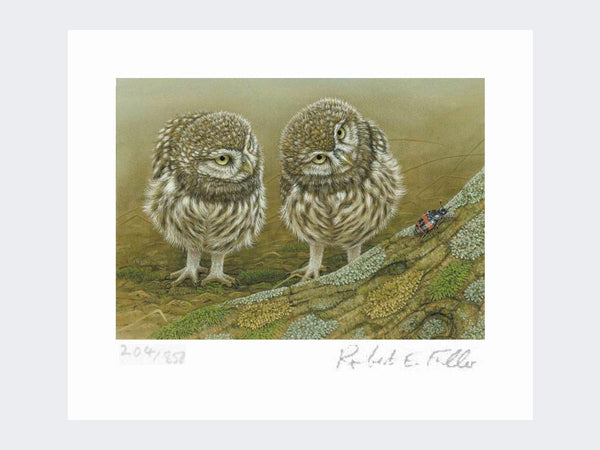
Short eared owls hunt in the day, which gives us an advantage when it comes to spotting them. Interestingly, you can tell what time of day an owl hunts by the colour of its eyes. Short eared owls have piercing yellow eyes, as do little owls and snowy owls. In comparison tawny owl eyes are almost black, which tells you that this owl species hunts mainly at night. My paintings below show you just how bright their eyes are.
When to look for short eared owls
The best time to see short eared owls in winter is during the late afternoon when it is not uncommon for large numbers of owls to hunt over the same patches. Although their hunting patterns can be erratic and unreliable, birdwatchers often share sightings so when I heard of a popular short eared owl hunting ground by the Humber I set off to look for them. I placed a chair and tripod on the edge of a large patch of rough grassland and waited. Before long a charm of goldfinches surrounded me, feeding on thistles among the tussocks of grass. I watched as buzzards, kestrels, marsh and hen harriers flew above me.
Eight short-eared owls
Then just before 2pm, as if out of nowhere, the air seemed to come alive with owls. I watched five short eared owls in the distance as they took it in turns to attack the marsh harrier. The attack looked almost synchronised as one by one they plummeted down like fighter planes mobbing a target. Eventually the harrier, which had been sitting in a tree, gave up and flew away.


Shortly afterwards, three more short eared owls joined the original five and all eight began quartering the grassland to hunt on their long wings. It was quite a spectacle. The flock now turned their attention to a buzzard which had been sitting on a fence post for the past two hours minding its own business. The owls soon moved him on and resumed their hunt, skimming the long grass looking for voles. It wasn’t long before one of the short eared owls spotted a perch close to me. It landed on the post for a few minutes, shook its feathers – it was so close I could see the water droplets as they spun off its streaked plumage – looked me in the eye, and then it was off chasing another owl away. It was a really special moment. Its eyes, which are set off by dark markings that look like heavily applied mascara, are so piercing they seemed to see right through me. The photograph I took of that moment became my reference for my painting.
Kestrel moves in
Suddenly I spotted one of the owls twist in the air and then plummet to the grass. I thought that perhaps it had caught something. But so did the kestrel I had spotted earlier. Within seconds the kestrel followed the short eared owl, diving into exactly the same spot in the grass. From my position, I couldn’t see exactly what happened next but there was clearly a tussle on the ground and the first to take flight was the owl, clutching a vole in its talons with the kestrel close behind. Despite the fact that this kestrel was dwarfed by the owl’s metre-long wingspan, the kestrel seemed determined to try and pinch the owl’s prey.


I watched the owl climb higher and higher into the sky with the kestrel in dogged pursuit. But as the owl extended its lead, calling out angrily at the kestrel, the kestrel changed its tactics. It moved away and then climbed higher than the owl. Then it turned and stooped back down towards the owl. Swooping underneath it, the kestrel grabbed the vole as it passed, leaving the owl in a bit of a spin.
The kestrel then hovered down to the ground, transferring the vole from his talons to his beak just before it landed, the sun just setting behind it. I have seen kestrels pinch meals off barn owls many times and the stealing has an official name, klepto-parasitism, but I was surprised to see one try it with a larger owl. It made for a spectacular end to a great afternoon.