
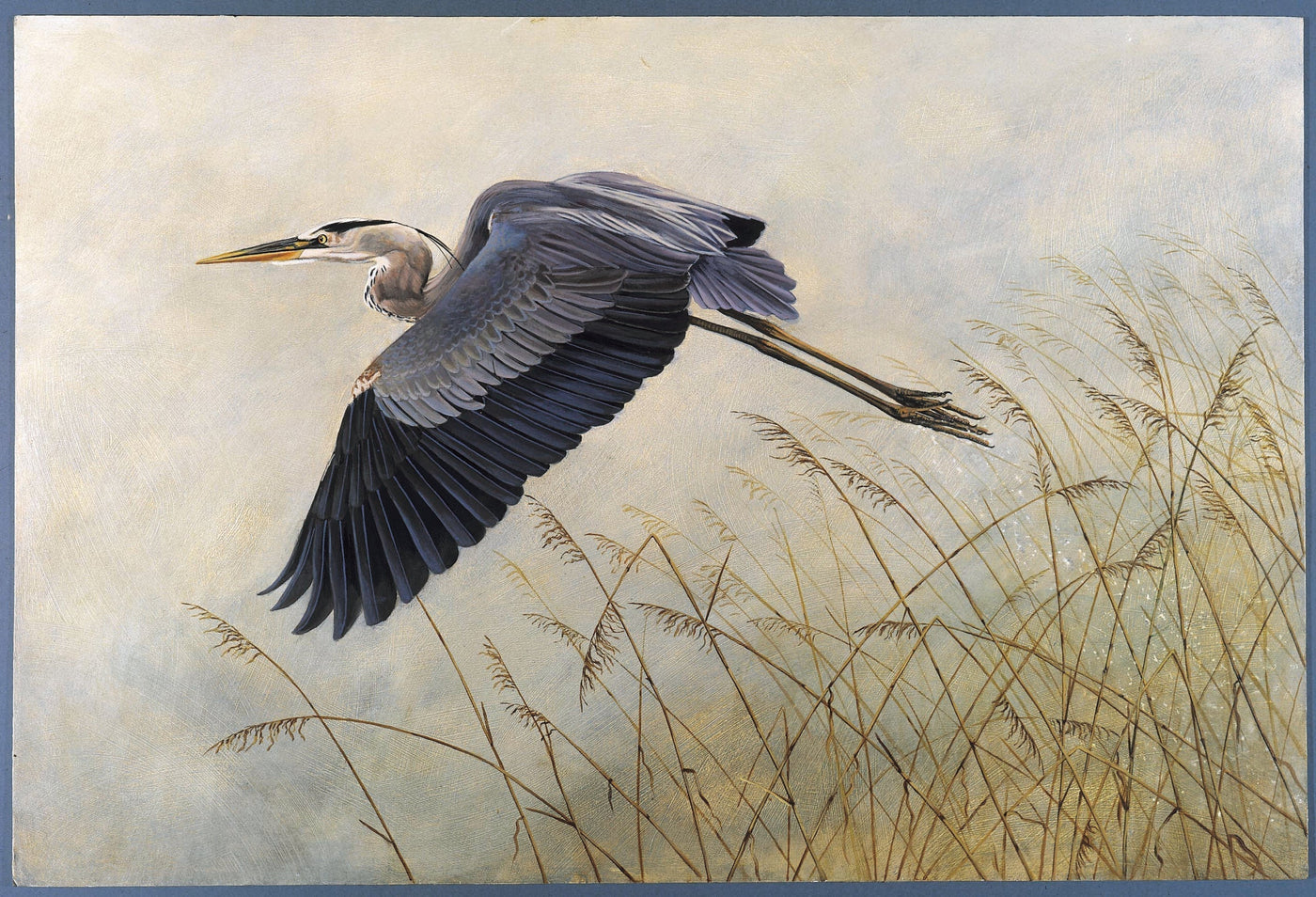

Portrait of a heron
A grey heron is a beautiful subject to paint. It always strikes an elegant pose and its long graceful neck and black, white and grey plumage offers such fluid lines. But this ancient bird’s liking for fish has meant it has been persecuted over the years.
Looking for a heronry
My first attempt to photograph a heronry was back in 1993 during a trip to the western isles of Scotland with my father. We were staying on the Isle of Uist and were having a successful trip, having spotted corncrakes, short-eared owls, red throated divers and even golden eagles.
Remote communal nest
Although there was distinct lack of trees there and few cliffs, one evening, as we scanned the opposite side of the bay with our binoculars, we picked out what looked like some large nests and grey birds. They were on some small cliffs over a mile away from our look out, so it was too far to say for sure, but it looked like a heronry. We got a map out that evening and identified the spot. It was at the end of an outcrop of land and the nearest road was nearly 10 miles away across open moor: too far to walk there and back in one day.
Ancient heronry
Herons nest communally, using the same nest each year, and some heronries can date back 40 or 50 years and vary in size from just four or five nests to 200. The lady running the B&B that we were staying in didn’t know whether there was a heronry nearby. She did, however, say that it would be easy enough to get a local fisherman to drop us off close to the cliffs the next morning. The plan was that we could then walk back. We woke early the following day to catch our lift. The fisherman didn’t know about whether there was a heronry at the spot either and so it was a relief when, just as we were beginning to doubt our instincts, we saw a heron perched on a small rocky island close to the cliffs. It wasn’t long before we also picked out a nest with a large chick sitting on it.
Heron chicks
The fisherman dropped us off in a cove around the corner from the site and we jumped out as he slowed down by a rocky outcrop. As we approached the heronry a couple of adult birds flew out across the sea letting out loud screeches as they went. We spent an hour photographing the chicks on up to 20 or so nests, but the adult birds stayed away throughout that time. It seemed a shame that the heronry was so inaccessible. I really wanted to put up a hide so that we could watch it for long enough for the adult birds to get used to our presence and return to attend to their young. But to build a hide you need to be able to put it up bit by bit so that the birds get used to it gradually and this site was just too difficult to get to and from in a day.
Lack of a hide
We left the herons in peace and started our walk back. Just over the horizon was an old derelict farm house. I wondered if this might make a base camp from which we could attempt making a hide. I ventured inside, but was soon overcome by a horrendous smell. It looked as though the sheep used this as a shelter in bad weather. I headed up the rickety stairs, but they collapsed before I got to the third step. Rock doves flew out of a window above and dust billowed down the stairs. I decided to leave the place to the wildlife - and livestock.
Urban heronry
I never did return and in the 18 years that have passed since I still haven’t been close enough to a heronry to get really good photographs. Most heronries in the countryside are difficult to photograph. Herons tend to choose very tall trees to build their nests in and it isn’t easy to train a camera on them as they sway in the wind. But then I happened to watch the BBC wildlife series, Springwatch, and caught an interesting programme in which presenter Simon King was feeding herons in London’s Regent’s Park. They were almost eating whitebait out of his hands!
So like him, I decided to take the easy option and go urban. It didn’t take me long to find the heronry in the park. But it was lunchtime when I arrived and it was crowded with picnickers. I was anxious that with all these people around the herons would not want to leave their nests. But soon after I arrived two herons flew out to a bridge close to all the picnickers. Clearly the herons were used to being fed there. I had brought a handful of raw meat along with me – strips of road kill pheasant and rabbit brought with me from Yorkshire rather than expensive whitebait – and I threw a few scraps down.
Regent's Park, London
Within minutes up to 15 birds were queuing up for morsels. Fights quickly broke out amongst them as they squabbled over the scraps and I realised that there was probably a pecking order as some herons dominated the space around me. Other people began to join in the feeding session, offering the herons everything from crisps to pizza – but curiously they ignored the junk food and followed me instead, eager for more roadkill.
Getting close to herons
There are 20 pairs nesting on the heronry in Regent’s Park and there has been a heronry there since 1968, although the tree that the herons originally used to nest in was damaged in the storms of 1987 when they moved to an island in the lake that they use to this day. The heronry is less than a mile from Oxford Street and is the closest heronry to a city centre in Europe. Consequently, the herons there are so uninhibited that I was able to get closer than I have ever been.
It was so exciting to be up so close and although it felt a little like cheating, after 18 years of trying to get some really good shots of these shy birds in the wild, I got some photographs that I was able to use to paint from.






2 comments
we have the great blue herons in northern new england.. i’ve camped and cabined on the beach in midcoast maine where there was always a resident great blue i could spot most early mornings and sometimes flying low from one end of the cove to the other right in front of my view. very occasionally i’d see them in vermont especially at the farm in strafford where i had that cabin tucked into a hillside. once there hiking down to my car i saw a heron fly into the top of a very tall tree which amazed me.. i’d never seen a heron in a tree.. and like you said the treetop was swaying back and forth while the bird held on :*).. must have been fun for the heron ! also so interesting about the old farmhouse you checked out for the hide.. thank goodness the stairs broke near the bottom and not at the top ! this blog is even better than your videos for the adventure story thanks 🙏
I have a beautiful and unusual shot of a heron sunbathing in a tree. I wonder if you’d like to see it?