
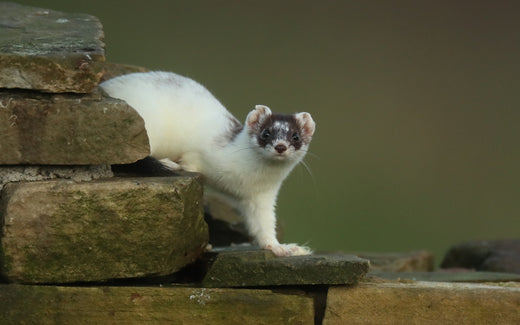
Turning white for winter
A handful of animal species have the remarkable ability to turn white in winter in order to match the snows of the season and the transition, which in the UK applies to ptarmigan - a genus of bird related to grouse - mountain hares and stoats, is something that fascinates me. Neither mountain hares nor ptarmigan are found in Yorkshire and although I have photographed and painted both, I haven’t had the opportunity to watch their transformations over any length of time. Stoats, however, are widespread across the British Isles.

A stoat named Bandita
But only a few stoats actually have the ability to turn white and these occur mainly in mountainous regions where snowfall is protracted. Sightings here in Yorkshire are rare. So when two winters ago, wildlife surveillance cameras hidden in my garden on the Yorkshire Wolds captured a female stoat halfway through her transition from chestnut-brown to white, I was delighted at the opportunity to record the process as it played out on my doorstep.
It was a cold winter and I had to step up my surveillance to follow this ghostly animal against the winter whiteout. By now she was a pure white except for a band of chestnut fur around her eyes, which made her look as though she was wearing a mask. I named this stoat Bandita in recognition of this marking and she has since become famous, starring in a BBC Natural World documentary which also featured on PBS in America thanks to my intensive surveillance.
Winter camouflage
Interestingly it wasn’t until Bandita had spent a year here and I had seen her transform from summer brown to snow white and back again that I realised I already knew this individual stoat. She was actually a stoat that had been born here two years previously and when I first started watching her I had named her Tash, after a thin ‘moustache’ line that crosses her muzzle. I follow the individual lives of animals closely for my paintings and this particular family of stoats have lived in my garden for generations. I know each individual well and so for me not to have recognised this stoat demonstrates just how effective its winter coat is as a disguise.

A blessing in disguise
Known as ermine, this coat is pure white except for the black tip of its tail and this unique patterning is something of a mixed blessing. Not only does it ensure the stoat stands out like a sore thumb in years where there is little snowfall, but it was also once a popular choice for ceremonial coats. When George VI was crowned in 1937 around 50,000 stoat pelts were said to have been imported for his robe and crown. The Queen wore this same ermine-trimmed robe and crown at her own coronation, the black tips of the stoat tails punctuating the edge at regular intervals.

Charting the transition
It took Bandita between five to six weeks to turn white that winter. It was mesmerising to watch as her beautiful brown coat slowly moulted and was replaced with gleaming white fur. Interestingly, the first part to turn white was a band of hair just above the black tip of her tail. She sported this black and white tail tip for some time before additional flecks of white began to appear at her muzzle.
At that time her five digits, already pale in colour, turned paler and paler until each paw was completely white. This bleaching then spread up her legs until it reached the creamy white band that remains under her belly all year round. The tips of her ears then whitened before the transition shifted back to her torso, the white hair wrapping right around her belly. Her back was the last part of her coat to moult and as it did she went through a patchy ‘pie bald’ stage.

I have read that stoats can turn white very fast - sometimes only taking a week or less - and that when this happens it is known as a ‘catastrophic moult’. But for Bandita the process was more gradual. And, interestingly, the moult followed the same pattern as it had that first year, with the first flecks of white appearing just above the black tip of her tail. Watch this film to see Bandita the stoat's transition into ermine.
Unpredictable weather
In theory the reason stoats wear ermine is so that they are camouflaged against snowy landscapes - but unfortunately climate change has meant that these white animals now stand out against stubbornly brown and green backdrops. So far this year we have had barely any snow and I’ve noticed that Bandita’s transition to ermine has been much slower. It has taken 41 days for her to moult and she has gradually gone from chestnut to a mottled-brown. Now all that is left is a ripple of brown dots stretching down her back like a cape.
An inherited trait
Only stoats with an inherited gene are able to perform the transition to ermine and, it seems, even these don’t turn completely white with the change of seasons. Bandita’s brother only ever developed the tell-tale band of white across his tail in his first year and although Bandita’s kits in 2018 were all very pale in colouring, only one remained in the garden for me to observe over winter and this one only developed a fringe of white around her muzzle, ears and cheeks. Last week, however, a pure white stoat was spotted on the valley opposite my home and I wonder if this could be one of Bandita’s last litter. Interestingly, in winters when there has been less snow cover, Bandita has turned only partially white.
White winter coats are warmer
Scientists believe that camouflage is not the only reason stoats turn ermine and that there are other advantages. They argue that a pale coat may be warmer, since when melanin, the substance responsible for coloured hair, is absent from white fur it leaves insulating air spaces in the hair shaft. The transition is understood to be triggered by both temperature change and a ‘switch’ in the stoat’s brains linked to ‘photoperiod’ - the amount of light received during the day. As the days shorten, receptors in the animal’s retina transmit the information to the brain, stimulating the replacement of brown fur to white.
Inspiration for my art
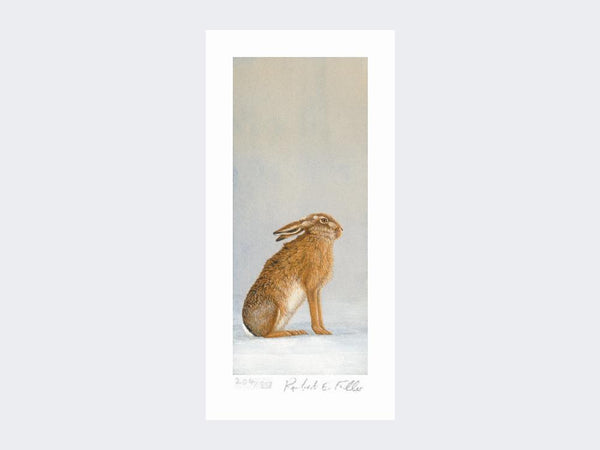
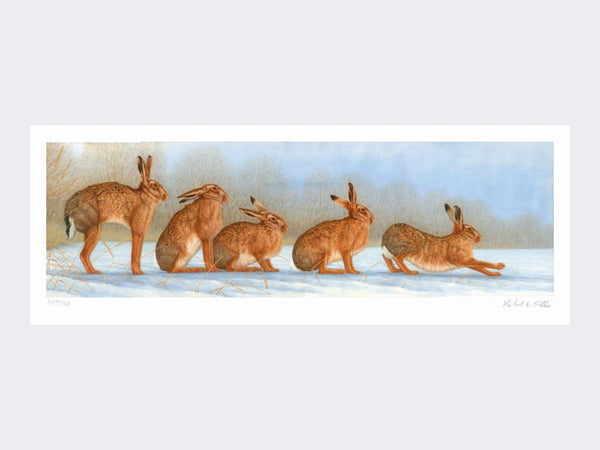
Shorter days are also understood to trigger mountain hares to turn white and during a recent, unseasonably cold, visit to Scotland I noticed that many were still in the process of transitioning. The sight of their mottled brown fur against the ice white snow inspired me to pick up my paintbrushes and capture the scene.
I've also painted Bandita in her ermine coat, choosing to set her against a plain, earthy coloured backdrop since I felt this really offset her winter coat.

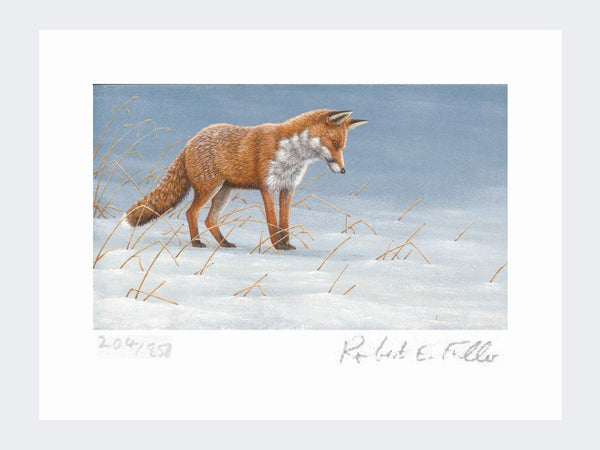
Bandita and her stoat family were also the inspiration for a collection of stoat & weasel paintings of which this is my favourite, since I think it reflects how precious this ermine stoat was and how much I treasured her time here in the garden.


2 comments
My wife feels sure that she caught a brief glimpse of a white stoat today 27/12/25 in woodland on Loxley common Sheffield
Hi Andrew
We have now got some stoat Christmas cards see here: https://www.robertefuller.com/collections/christmas-cards/products/christmas-is-coming-pack-of-5-christmas-cards